
Most people in the Pro-Science™ crowd aren't interested in science itself, they're just interested in social signalling that they are smart and educated.For once, instead of a "Crap from Facebook" post, here's something I actually think has merit. It captures some stuff I've been pondering lately. There are a lot of people online, but also some I know in-person, who wear their "pro-science" on their sleeves. They're proud supporters of science and ostensibly hostile toward superstition and pseudoscience. That's not the same thing as actually having any knowledge of scientific concepts, and that's why they like to play it safe, or stay where they think it's safe.
That's why they mostly focus on irrelevant lowest-common-denominator crap like flat earth and creationism.
Tuesday, July 9, 2019
"Pro-Science" pandering
I happened across this statement on Facebook...

Monday, July 1, 2019
Wait, what? A drinking straw has one hole. Everyone already knew that, right?
A while back I wrote a post about the not-so-brainteasing topic of hot dogs being referred to as sandwiches. It's silly, but the part about it that is silly to me isn't necessarily the same aspect that most people would find silly. It seems like commonly, when this topic is discussed, both sides attempt to exercise discursive techniques familiar from formal debates. They attempt to establish definitions of terms that they think will favor their own side. They refer to patterns and attempt to arrange various premises and contentions in such a way as to build a case that their side wins. It's the sort of stuff that I'd find interesting in another context, but it seems that the parties involved all forgot that they stumbled into an area where the terms exist within the context of a professional field of study, and that there is a definitive right answer. A definitive right answer, especially one that is readily available and rather clear-cut, tends to stand rather triumphantly against any kind of debate tricks, no matter how clever or sophisticated those tricks might be. So to recapitulate, hot dogs are not sandwiches because the terms "hot dog" and "sandwich" in the context of foods are terms coined by chefs, terms which exist in the context of culinary traditions. It's a rather mundane Q.E.D. to respond to some rather elaborate verbal hedging by both sides of the aisle. But then, that's how these things often work out.
To my surprise, I recently found another not-so-brainteasing question come up alongside the hotdog/sandwich topic: "How many holes does a drinking straw have?" My initial response as soon as I read that one was something like, "I think it's one, right? I mean, topology isn't really in my wheelhouse, but this is an exceedingly basic question and unless there's some trick, I know it's going to be one." And then I had the followup thought of, "Someone has probably already asked a topologist this question, so let's look it up on the internet." I was, in both instances, correct on all counts. It's an easy problem for topology, people have already asked topologists, and the answer is, indeed, one. Well, that was easy.
What's strange and frustrating to me about this, though, is that I guess I expected better. The hotdog thing seems more like a forgivable sort of mistake. The sort of people who like to argue about these things are nerds. A lot of them are into or familiar with physics, biology, epistemology, information science, etc. And perhaps the sort of nerds who are culinary nerds are also not the sort to get dragged into such arcane debates. So it becomes a topic with all sorts of irrelevant philosophical debate, because there just aren't enough people with both an interest in getting involved and the sense to remind the participants that there's already a system of nomenclature established for these things. At least, I thought that was what was going on, at the time I wrote the hotdog post. The nerds who nerd it up with elaborate discussions on abstract debate topics like "Does X count as Y" just might not have much overlap with people who are interested in culinary history. So they miss the point and look a bit silly to me, but it's the kind of mistake I guess I expected. But how many holes an object has? Surely many of these same sorts of nerds are also math nerds! Surely even the ones who don't know much topology know enough to know that it exists and know enough to look to topology for an answer. Right? Right? Apparently not.
And on that, I'm stumped. Here we have the sort of question that...
To my surprise, I recently found another not-so-brainteasing question come up alongside the hotdog/sandwich topic: "How many holes does a drinking straw have?" My initial response as soon as I read that one was something like, "I think it's one, right? I mean, topology isn't really in my wheelhouse, but this is an exceedingly basic question and unless there's some trick, I know it's going to be one." And then I had the followup thought of, "Someone has probably already asked a topologist this question, so let's look it up on the internet." I was, in both instances, correct on all counts. It's an easy problem for topology, people have already asked topologists, and the answer is, indeed, one. Well, that was easy.
What's strange and frustrating to me about this, though, is that I guess I expected better. The hotdog thing seems more like a forgivable sort of mistake. The sort of people who like to argue about these things are nerds. A lot of them are into or familiar with physics, biology, epistemology, information science, etc. And perhaps the sort of nerds who are culinary nerds are also not the sort to get dragged into such arcane debates. So it becomes a topic with all sorts of irrelevant philosophical debate, because there just aren't enough people with both an interest in getting involved and the sense to remind the participants that there's already a system of nomenclature established for these things. At least, I thought that was what was going on, at the time I wrote the hotdog post. The nerds who nerd it up with elaborate discussions on abstract debate topics like "Does X count as Y" just might not have much overlap with people who are interested in culinary history. So they miss the point and look a bit silly to me, but it's the kind of mistake I guess I expected. But how many holes an object has? Surely many of these same sorts of nerds are also math nerds! Surely even the ones who don't know much topology know enough to know that it exists and know enough to look to topology for an answer. Right? Right? Apparently not.
And on that, I'm stumped. Here we have the sort of question that...
- Seems obviously to be a topology question.
- Has an easy, readily available answer in topology.
- Has a definitive answer from the field of topology that also would seem to happen to match the most intuitive answer (from my perspective, anyway), so there shouldn't be much objection.
Monday, May 20, 2019
Damned lies and statistics?
After a bit of a dry spell, I've been getting back into playing League of Legends a bit more. Now, I never really left, but it's also not really the same. Not really. I've not brought it up lately, but I used to be really into the game, and now, not so much. They reworked almost all of my own champions and now my old methods don't work. I do still have, Karthus, Sivir, Sona, Amumu, Singed, and Udyr more or less intact. I'm probably also fine with Malzahar and Anivia. There are probably some others I can still play. But gone are the days when I had a system mapped out to play almost any champion. For most of 2018, I'd pop in and play some bot games occasionally and not too much else. I'm still leaving Ranked play alone for now. It's been all blink pick normals lately.
That's all a preface to something else, but the "something else" in this case goes way back, much further than the rest of this. I'll use my blind pick normals as an example. Without checking, I think the story is much the same for other gameplay modes. Anyway...
Back when I was really into LoL, I'd frequent the forums. A topic that would come up would be complaints about unfair matchmaking, bias in the algorithms, and such. Mostly, this was for Ranked play, but that point doesn't matter very much anyway. The complaint was across the board and so was the rebuttal. Typically, some player would describe how he or she was playing well and trying to win, but kept losing and falling in the rankings because they'd get toxic teammates. And some voice of wisdom would respond to this with a story. A brief story consisting of premises and conclusions to those premises.
Let's assume that you're playing the game and trying to win. You pay attention, you work with your teammates, you do your best, you try to hone your skills, etc. Barring rare outlier circumstances, you're not leaving the game or disconnecting from it. Now, in the game are nine other players. There's some chance that one of them is a problem, a liability. A player might have egregious connection problems, might abandon the game partway through, might never show up at all. Or perhaps someone else might grief or might rage or troll teammates, compromising the game. The matchmaking algorithms don't stop those from happening, but they do distribute such problems evenly. In a random game, each team has 5 players and any 1 of those 5 on either team might be the toxic element. But not you. As you are not going to be the toxic element, this means your team only has 4 players that might be the toxic element costing their team the game. So, in a game where there's a single toxic element, it's going to be on the other team 5/9ths of the time and on your team 4/9ths of the time. Sometimes there won't be any toxic element at all, but those games are 50/50 for you anyway. But over a long enough time, that 11.1% will grind the average of your opponents into the ground. Some games might have multiple toxic elements, but that doesn't change this anyway. Initially, the matchmaking algorithms might be causing you to lose by placing you too high, and you'll lose more for a while until you settle into your appropriate skill level or whatever. But once that part is out of the way, if you're diligent and non-toxic, your wins will overtake your losses. It's statistics.
And it's a fine story. It's a damn fine story, actually. Eminently persuasive. Logically sound. It just happens to have the misfortune of being wrong. Oh, it's convincing. But wrong is wrong.
My win percentage in blind pick normals, the mode I'm currently focused on, is 49%. If this was over the course of 100 games, I'd put it down to small sample size. 300 games and still, it's easy to imagine that I'm just on the wrong side of variance. It could happen. Someone out there is going to be in the wrong part of the confidence interval. But I don't have 100 of these games and I don't have 300. I have over 1,500 of these games recorded, and my win percentage has been below 50% for years. It's a pattern that seems to have carried over to other game modes too. I lose more than I win.
I have my suspicions as to why this is the case, but the important point in this post is that it is the case. Learning why is another matter.
That's all a preface to something else, but the "something else" in this case goes way back, much further than the rest of this. I'll use my blind pick normals as an example. Without checking, I think the story is much the same for other gameplay modes. Anyway...
Back when I was really into LoL, I'd frequent the forums. A topic that would come up would be complaints about unfair matchmaking, bias in the algorithms, and such. Mostly, this was for Ranked play, but that point doesn't matter very much anyway. The complaint was across the board and so was the rebuttal. Typically, some player would describe how he or she was playing well and trying to win, but kept losing and falling in the rankings because they'd get toxic teammates. And some voice of wisdom would respond to this with a story. A brief story consisting of premises and conclusions to those premises.
Let's assume that you're playing the game and trying to win. You pay attention, you work with your teammates, you do your best, you try to hone your skills, etc. Barring rare outlier circumstances, you're not leaving the game or disconnecting from it. Now, in the game are nine other players. There's some chance that one of them is a problem, a liability. A player might have egregious connection problems, might abandon the game partway through, might never show up at all. Or perhaps someone else might grief or might rage or troll teammates, compromising the game. The matchmaking algorithms don't stop those from happening, but they do distribute such problems evenly. In a random game, each team has 5 players and any 1 of those 5 on either team might be the toxic element. But not you. As you are not going to be the toxic element, this means your team only has 4 players that might be the toxic element costing their team the game. So, in a game where there's a single toxic element, it's going to be on the other team 5/9ths of the time and on your team 4/9ths of the time. Sometimes there won't be any toxic element at all, but those games are 50/50 for you anyway. But over a long enough time, that 11.1% will grind the average of your opponents into the ground. Some games might have multiple toxic elements, but that doesn't change this anyway. Initially, the matchmaking algorithms might be causing you to lose by placing you too high, and you'll lose more for a while until you settle into your appropriate skill level or whatever. But once that part is out of the way, if you're diligent and non-toxic, your wins will overtake your losses. It's statistics.
And it's a fine story. It's a damn fine story, actually. Eminently persuasive. Logically sound. It just happens to have the misfortune of being wrong. Oh, it's convincing. But wrong is wrong.
My win percentage in blind pick normals, the mode I'm currently focused on, is 49%. If this was over the course of 100 games, I'd put it down to small sample size. 300 games and still, it's easy to imagine that I'm just on the wrong side of variance. It could happen. Someone out there is going to be in the wrong part of the confidence interval. But I don't have 100 of these games and I don't have 300. I have over 1,500 of these games recorded, and my win percentage has been below 50% for years. It's a pattern that seems to have carried over to other game modes too. I lose more than I win.
I have my suspicions as to why this is the case, but the important point in this post is that it is the case. Learning why is another matter.
Monday, March 18, 2019
Bahl's First Theorem of Lyrical Criticism
For seemingly no particular reason, I've recently happened on the writings of others in the field that could generally be described as music criticism. I noticed something that now seems obvious, but which I've never seen articulated before. It's both simple and confounding. It piqued my interest enough to bother posting about it here...
In any lyrical composition (music or poetry) employing rhyme, in order for a prospective critic to make any use of rhyme seem banal, lazy, vulgar, or trite, all that is necessary is to directly describe the work as a whole in such terms, followed immediately by a recounting of which words were rhymed with which words.
This might seem like a weird statement on my part, but it's easy enough to substantiate. Look for criticism of any music or poetry involving rhyme and you'll pretty quickly run into the critic doing exactly what I just described. What's so strange is that it works! No matter how you craft your verse, all I need to do to attack your use of rhyme is to call it stupid, then point out which words you rhymed.
Notably, there are some other possible criticisms involving the concept of rhyme. I, myself, have frequently disparaged the rhyming of a word with itself. Some people hate "near-rhyme" and then there are those lyricists who don't even bother with that and just throw in a non-rhyme and pretend that they've used a rhyme, as though the audience won't notice. But when it comes to true rhyme, one rhyme is much the same as any other. Conveniently, this means they're all about as easy to mock.
In any lyrical composition (music or poetry) employing rhyme, in order for a prospective critic to make any use of rhyme seem banal, lazy, vulgar, or trite, all that is necessary is to directly describe the work as a whole in such terms, followed immediately by a recounting of which words were rhymed with which words.
This might seem like a weird statement on my part, but it's easy enough to substantiate. Look for criticism of any music or poetry involving rhyme and you'll pretty quickly run into the critic doing exactly what I just described. What's so strange is that it works! No matter how you craft your verse, all I need to do to attack your use of rhyme is to call it stupid, then point out which words you rhymed.
Notably, there are some other possible criticisms involving the concept of rhyme. I, myself, have frequently disparaged the rhyming of a word with itself. Some people hate "near-rhyme" and then there are those lyricists who don't even bother with that and just throw in a non-rhyme and pretend that they've used a rhyme, as though the audience won't notice. But when it comes to true rhyme, one rhyme is much the same as any other. Conveniently, this means they're all about as easy to mock.
Tuesday, February 19, 2019
Hot dogs are not sandwiches
I recently saw this debate brought up again and realized that I haven't ever truly weighed in on it. So let's set the record straight once and for all.
I'm too lazy to look up the kind of detailed description of the debate that I imagine I'd find if I did a quick internet search, so do that yourself. Or trust my flawed recollection of it.
The initial question "Is a hot dog a sandwich" is used as a kind of prompt to encourage exercising critical thinking skills. There are a variety of interesting responses to the prompt and one ultimate, objectively correct answer, which I've never actually witnessed another human being provide. We'll come to that. But to set the stage, I need to recount the typical responses...
The average person knows intuitively that the affirmative side in the debate is wrong, so the affirmative side generally clings to a rigid framework of some hypothetical sandwich classification schematic. They stick to a point along the lines of "These other objects are all sandwiches and they have these properties in common, so another object with those properties (meat and other contents held inside bread) is, by definition, also a sandwich." Meanwhile, the negative side tends toward pithy ace-in-the-hole counterpoints. The most popular of these seem to be...
The problem is that the negative side in the debate, the "not a sandwich" camp, are right, but seem to be unable to articulate the real reason that a hot dog is not a sandwich. So I, in all my splendorous wisdom, am here to tell you the right reasons that the "hotdog is a sandwich" camp is wrong.
There's a hint. Earlier in this post I noted that the argument for the affirmative side hinges on invoking a taxonomic classification scheme. They want to rigorously define different categories of food. Although they do not normally need to go so far as to construct diagrams, they're clearly drawing inspiration from existing systems of classifications used professionally by experts in other fields, such as engineering and biology. They create, or refer to the hypothetical creation of, a systematic approach to defining foods in different categories, as though the foods are machine parts or flowering plants. Then the word "sandwich" is matched to objects already established to have the name and the list of properties associated with the label are deduced from the features those objects have in common. Those arguing for the affirmative are acting as detectives trying to map out the logic to determine what is and is not a sandwich. The huge, gaping flaw in all of this is that there's already an established professional classification scheme for food and it is based on food preparation. The names assigned for food are assigned by food creators, by chefs. We know where the names come from. They are not assigned post-hoc by investigators endeavoring to establish a classification scheme. They come from chefs.
The origins of the term "hot dog" are unclear and it is used inconsistently, sometimes applied to sausage alone and other times applied to the sausage + bun combination. The former is older, which might matter if that was the topic of the debate. But the relevant part is that hot dogs have been around for well over a century and that they were not marketed as or thought of as sandwiches because the history of their creation is different. In a meat sandwich, the emphasis is on placing the meat and other ingredients on or into the bread. Keep in mind that the term is a culinary term, so we're concerned with food preparation here. In evaluating a culinary term, it makes no sense to step outside of the culinary realm and act like we're space aliens observing the object with no prior information. The term is a culinary term, so the preparation of the object as food is the impetus for the term used to describe the object. And while lots of sandwiches have their own steps involved, the unifying element is the placement of contents on or into bread. A hot dog isn't like that. It is created in a factory or sausage shop, then packed and shipped to a food vendor. It is then unpacked, cooked, and added to a bun. Then toppings and condiments, aka "fixings" are added and the combined product is sold and consumed as a "hot dog." It is definitely true that applying the same label to the initial sausage and to the finished product is muddled and is not the way we'd want to do things if we were establishing a taxonomic system from scratch. But that's how it goes! The term demonstrably gets applied, widely, to both. That's the culinary usage. The traditions and the emphases in the two culinary traditions are distinct. To dismiss this is folly.
Q.E.D.
I'm too lazy to look up the kind of detailed description of the debate that I imagine I'd find if I did a quick internet search, so do that yourself. Or trust my flawed recollection of it.
The initial question "Is a hot dog a sandwich" is used as a kind of prompt to encourage exercising critical thinking skills. There are a variety of interesting responses to the prompt and one ultimate, objectively correct answer, which I've never actually witnessed another human being provide. We'll come to that. But to set the stage, I need to recount the typical responses...
- One party might argue that a hot dog is not a sandwich because a sandwich consists of contents (such as meat) between two pieces of bread. A hot dog bun is a single piece of bread.
- Another party might argue that a hot dog is a sandwich because a sandwich consists of contents (such as meat) and bread to hold the contents in some way. Other items that are, by widespread consensus, known as sandwiches, use configurations other than the traditional two slices of bread with contents between them. A hot dog meets the same criteria as those sandwiches.
The average person knows intuitively that the affirmative side in the debate is wrong, so the affirmative side generally clings to a rigid framework of some hypothetical sandwich classification schematic. They stick to a point along the lines of "These other objects are all sandwiches and they have these properties in common, so another object with those properties (meat and other contents held inside bread) is, by definition, also a sandwich." Meanwhile, the negative side tends toward pithy ace-in-the-hole counterpoints. The most popular of these seem to be...
- Defining a hot dog as the sausage itself and insisting that no matter what the sausage + bun combination is classified as, the hot dog has no bread and is not a sandwich.
- Asserting that language exists to facilitate communication and that because most people do not think of hot dogs as sandwiches, it is improper to classify a hot dog as a sandwich.
The problem is that the negative side in the debate, the "not a sandwich" camp, are right, but seem to be unable to articulate the real reason that a hot dog is not a sandwich. So I, in all my splendorous wisdom, am here to tell you the right reasons that the "hotdog is a sandwich" camp is wrong.
There's a hint. Earlier in this post I noted that the argument for the affirmative side hinges on invoking a taxonomic classification scheme. They want to rigorously define different categories of food. Although they do not normally need to go so far as to construct diagrams, they're clearly drawing inspiration from existing systems of classifications used professionally by experts in other fields, such as engineering and biology. They create, or refer to the hypothetical creation of, a systematic approach to defining foods in different categories, as though the foods are machine parts or flowering plants. Then the word "sandwich" is matched to objects already established to have the name and the list of properties associated with the label are deduced from the features those objects have in common. Those arguing for the affirmative are acting as detectives trying to map out the logic to determine what is and is not a sandwich. The huge, gaping flaw in all of this is that there's already an established professional classification scheme for food and it is based on food preparation. The names assigned for food are assigned by food creators, by chefs. We know where the names come from. They are not assigned post-hoc by investigators endeavoring to establish a classification scheme. They come from chefs.
The origins of the term "hot dog" are unclear and it is used inconsistently, sometimes applied to sausage alone and other times applied to the sausage + bun combination. The former is older, which might matter if that was the topic of the debate. But the relevant part is that hot dogs have been around for well over a century and that they were not marketed as or thought of as sandwiches because the history of their creation is different. In a meat sandwich, the emphasis is on placing the meat and other ingredients on or into the bread. Keep in mind that the term is a culinary term, so we're concerned with food preparation here. In evaluating a culinary term, it makes no sense to step outside of the culinary realm and act like we're space aliens observing the object with no prior information. The term is a culinary term, so the preparation of the object as food is the impetus for the term used to describe the object. And while lots of sandwiches have their own steps involved, the unifying element is the placement of contents on or into bread. A hot dog isn't like that. It is created in a factory or sausage shop, then packed and shipped to a food vendor. It is then unpacked, cooked, and added to a bun. Then toppings and condiments, aka "fixings" are added and the combined product is sold and consumed as a "hot dog." It is definitely true that applying the same label to the initial sausage and to the finished product is muddled and is not the way we'd want to do things if we were establishing a taxonomic system from scratch. But that's how it goes! The term demonstrably gets applied, widely, to both. That's the culinary usage. The traditions and the emphases in the two culinary traditions are distinct. To dismiss this is folly.
Q.E.D.
Tuesday, February 12, 2019
Schloss Grünfluss and Seattle Snowmageddon 2019
Obligatory mention that I don't post here nearly enough. I know, I know. I say it all the time and I mean it every time, but I continue to transgress. It's been months. I'll totally turn this ship around. I can do better. I will do better. What's so difficult about checking in every once in a while and writing a blog entry or something? Nothing. Nothing difficult about it at all. I'll do it.
Posting here has the effect of taking me back to the LJ days. Mentally, not literally. Of course, but you knew that. Anyway, some minor details in the presentation, combined with prompting from friends and the whole vast community weirdness of it, well, it impelled me toward journal posts of a personal nature. I mean, I didn't share stuff that I didn't want to be made public! I'm not that stupid. I knew I was, by definition, making that information public. I don't think I was foolish to share the things I did, but there's a marked difference anyway. Well, I note the difference, but I never really pinned down the reason. Still can't.
Maybe it's just that I'm older. More grown up. Time has passed, of course, but I don't buy it. Could it have been the interaction with friends? Seems like a more plausible explanation. I was not and am not consciously worried about some sort of unforeseen social consequences for my public sharing of personal details and meandering introspection. In fact, I remember, years ago, coming across this strip...
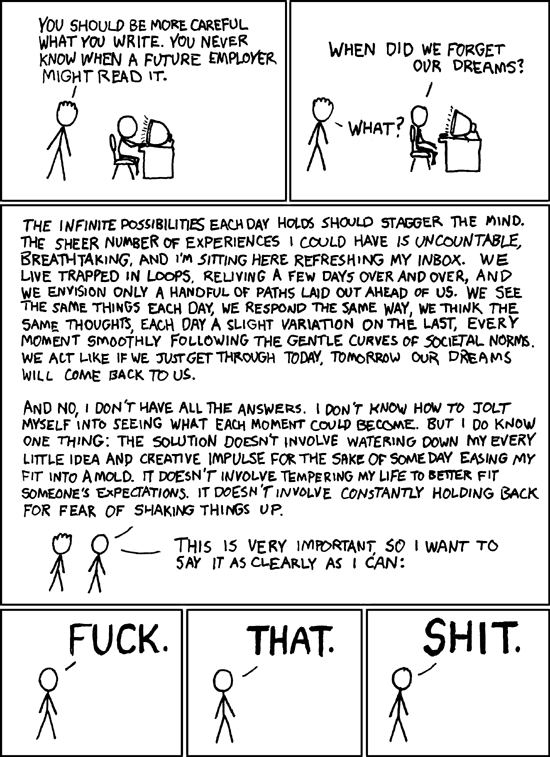
It resonated with me then, and it still does today. I haven't been holding back because I worry what other might think. Instead, I've been holding back due to some inexplicable torpor. I didn't stop sharing out of fear or maturity or because I decided it was wise. I stopped sharing out of habit. I stopped sharing because it felt easier, because it felt like journaling was becoming a chore.
Even in the LJ days it wasn't all personal. I used that site as a sounding board for everything I wanted to say. I shared links, I posted essays of a kind, I created strange and wonderful communities, and I created a kind of narrative that bound myself and others up into something I'd not initially expected. Oh, it was probably trite or banal more than I'm remembering now, but I did produce some real content and managed to do so on a surprisingly regular basis. I did all that when the whole plan at the start was just to have a "journal." I wrote about what was on my mind, about what was going on in my life, and anyone could see it. My dad even found my LJ one time, and I remember that well. Now I have a blog no one reads. This started out as something more serious, something I was going to use to devote more time to longform content. More editorial, although not truly professional. But I think it's been forgotten by everyone except me. I could say anything and probably no one else would see it. On LJ I refused to censor myself even though people probably were going to see it (and did). Here on Blogger, I changed to a platform that was effectively private, but I couldn't be bothered to talk about things. The irony isn't lost on me.
I know I've brought it all up before. It's important to me, though. When I've reviewed my old content, it's restored memories that were seemingly lost, and it's left me wondering about the gaps. But this place, this half-assed effort, is too sparse. I earnestly want to change that. Go back through my posts for the past several years though, and see that I've expressed that sentiment before.
My last post on LJ, titled "#600" was my goodbye of sorts. Reading it again now, it's surreal. So much that's important is still the same. But strikingly, so much has changed. And I filled in some of the gaps using this blog, but I forget how and when? I worry about those details that weren't filled in? How much did I talk about my graduation from Green River? How much did I talk about my trip to Europe? They both happened later that same year! And then I moved to Seattle (temporarily) and went to the University of Washington and graduated there too and floundered in unemployment again for a time and then got a job again and, well, on and on it went. Life happened. Time progressed. So much to talk about. I think, in a way, I became paralyzed by how far behind I was. Such a stupid excuse for my lack of activity here, but it rings true. I had some ideal in my head for all the things I'd say when it came to my experiences at the University of Washington, but I didn't take the time to post about it here. It dragged on and I know I thought I'd make up for it some day with some giant retrospective post. But that became too daunting and inertia took care of the rest. So much time passed I even went and got a job there. Huh. I feel like I probably mentioned the job at some point, but did I?
I can't really undo the lost years. I can't repair this. Not fully. But let's try anyway. And instead of trying to play catch-up, let's start here. Let's start where we are.
I bought a house. There's more to it. A whole lot of things happened that led up to this. But we'll catch up on those matters or we won't. The important part here, the focus, is that I bought a house. I have moved to Auburn. That's where the house I bought is, so it seemed sensible to move there. I am calling my house "Schloss Grünfluss." It's my house, so I get to call it whatever I want. I don't mind telling you that it's actually kind of between the Green River and the White River, so I had in mind some variation on the name "Mesopotamia" but I gave up on that. No, Schloss Grünfluss it is.
The move is pretty recent. I had some plans for getting settled in, and they've hit a bit of a snag in the form of the heaviest, most prolonged snowfall that the Puget Sound area has experienced in a long time...

Posting here has the effect of taking me back to the LJ days. Mentally, not literally. Of course, but you knew that. Anyway, some minor details in the presentation, combined with prompting from friends and the whole vast community weirdness of it, well, it impelled me toward journal posts of a personal nature. I mean, I didn't share stuff that I didn't want to be made public! I'm not that stupid. I knew I was, by definition, making that information public. I don't think I was foolish to share the things I did, but there's a marked difference anyway. Well, I note the difference, but I never really pinned down the reason. Still can't.
Maybe it's just that I'm older. More grown up. Time has passed, of course, but I don't buy it. Could it have been the interaction with friends? Seems like a more plausible explanation. I was not and am not consciously worried about some sort of unforeseen social consequences for my public sharing of personal details and meandering introspection. In fact, I remember, years ago, coming across this strip...
It resonated with me then, and it still does today. I haven't been holding back because I worry what other might think. Instead, I've been holding back due to some inexplicable torpor. I didn't stop sharing out of fear or maturity or because I decided it was wise. I stopped sharing out of habit. I stopped sharing because it felt easier, because it felt like journaling was becoming a chore.
Even in the LJ days it wasn't all personal. I used that site as a sounding board for everything I wanted to say. I shared links, I posted essays of a kind, I created strange and wonderful communities, and I created a kind of narrative that bound myself and others up into something I'd not initially expected. Oh, it was probably trite or banal more than I'm remembering now, but I did produce some real content and managed to do so on a surprisingly regular basis. I did all that when the whole plan at the start was just to have a "journal." I wrote about what was on my mind, about what was going on in my life, and anyone could see it. My dad even found my LJ one time, and I remember that well. Now I have a blog no one reads. This started out as something more serious, something I was going to use to devote more time to longform content. More editorial, although not truly professional. But I think it's been forgotten by everyone except me. I could say anything and probably no one else would see it. On LJ I refused to censor myself even though people probably were going to see it (and did). Here on Blogger, I changed to a platform that was effectively private, but I couldn't be bothered to talk about things. The irony isn't lost on me.
I know I've brought it all up before. It's important to me, though. When I've reviewed my old content, it's restored memories that were seemingly lost, and it's left me wondering about the gaps. But this place, this half-assed effort, is too sparse. I earnestly want to change that. Go back through my posts for the past several years though, and see that I've expressed that sentiment before.
My last post on LJ, titled "#600" was my goodbye of sorts. Reading it again now, it's surreal. So much that's important is still the same. But strikingly, so much has changed. And I filled in some of the gaps using this blog, but I forget how and when? I worry about those details that weren't filled in? How much did I talk about my graduation from Green River? How much did I talk about my trip to Europe? They both happened later that same year! And then I moved to Seattle (temporarily) and went to the University of Washington and graduated there too and floundered in unemployment again for a time and then got a job again and, well, on and on it went. Life happened. Time progressed. So much to talk about. I think, in a way, I became paralyzed by how far behind I was. Such a stupid excuse for my lack of activity here, but it rings true. I had some ideal in my head for all the things I'd say when it came to my experiences at the University of Washington, but I didn't take the time to post about it here. It dragged on and I know I thought I'd make up for it some day with some giant retrospective post. But that became too daunting and inertia took care of the rest. So much time passed I even went and got a job there. Huh. I feel like I probably mentioned the job at some point, but did I?
I can't really undo the lost years. I can't repair this. Not fully. But let's try anyway. And instead of trying to play catch-up, let's start here. Let's start where we are.
I bought a house. There's more to it. A whole lot of things happened that led up to this. But we'll catch up on those matters or we won't. The important part here, the focus, is that I bought a house. I have moved to Auburn. That's where the house I bought is, so it seemed sensible to move there. I am calling my house "Schloss Grünfluss." It's my house, so I get to call it whatever I want. I don't mind telling you that it's actually kind of between the Green River and the White River, so I had in mind some variation on the name "Mesopotamia" but I gave up on that. No, Schloss Grünfluss it is.
The move is pretty recent. I had some plans for getting settled in, and they've hit a bit of a snag in the form of the heaviest, most prolonged snowfall that the Puget Sound area has experienced in a long time...
Monday, November 5, 2018
It is oh-so-very important to me that other people vote, for some reason
I've long wondered why, every two years (or really whenever there's a major election), I hear and see so much emphatic "you must go vote" rhetoric. If it were more specific, "vote for this" or "don't vote for that" then I'd have thought little of it. But more often, it's been a simple a simple exhortation on the act of voting itself. I've always thought that this was absurd...
Encouraging other people to vote, though? No personal gain, no immediately obvious reason. It can't even be for the cause of advancing a political agenda because you have no reason to expect that your interlocutors would vote along your lines. Obviously that part doesn't apply if you're talking to specific people you know and you can gauge some of their beliefs and such. If think to myself, "Timmy doesn't really want to vote, but he agrees with me on most stuff, so if I convince him to vote, it'll be more votes for the stuff I want" then at least there's a kind of potential gain. I wouldn't go for that sort of thing myself, but I could understand that others might. However, that only applies to specific, reasonably close, acquaintances. And what I've encountered more commonly is general, vocal, public exhortation. And for that, a political agenda doesn't really apply.
For probably close to a decade, my best guess was that this whole phenomenon was some combination of virtue-signalling and a meme. And maybe both of those do play a role. Both are rather more nuanced than my straightforward sentence here. Virtue-signalling could tie into a generalized notion of "civic duty" but also to notions of youth and mentoring, to community development. And saying something is a meme says nothing about why it's a meme. I do believe that some of this is because of behaviors that are replicated after observation, spreading across the population like an infection, but behaviors only do that under certain conditions, and I couldn't be sure what those conditions were. I still can't.
In the past few years, I've been revising my assessment of this topic. I don't doubt that virtue-signalling plays a role and that some of the behaviors involved are memetic. But I've come to place the bulk of the blame elsewhere. I suspect that most of the people exhorting others to vote are doing so because they earnestly believe that the people they're exhorting would vote along their own lines. They truly think, on some level, that they can encourage others to vote and that those people, who might not have bothered to vote at all, will happen to check the same boxes that they themselves intend to check.
This seems so patently silly that even though I must have first considered it many years ago, I didn't take it seriously. What changed? Well, it wasn't a single, monumental thing. It's just the accumulated weight of my observations and what they've taught me. The vote-encouragers are almost always politically entrenched in some pronounced, polarized manner. Oh, they've got their own quibbles with a given political party or movement. They've got nuance and depth. But they've also come to so strongly view the other side as so cartoonishly villainous, so egregiously evil, so obviously wrong, that they sincerely believe prospective fence-sitters see things in the same light. A kind of "Yes, perhaps Timmy doesn't see things in the way I do, and perhaps he has problems with the general atmosphere in 'A.' But 'B' is so bad that anyone could see it, and Timmy would never vote for them."
I should have noted this fallacy a long time ago and given it the proper appreciation I now think it deserves. Because I think it's very common. Wherever people get split into two camps, people in both camps will tend to believe that the uninvolved would probably mostly side with them. They extend their own distaste for the the other side into reality itself, perceiving it to be a tangible, visible miasma.
Actually, I wonder if this might just be an extension of some deeper human instinct. In the absence of contrary information, I assume that the tastes of others are similar to my own. So I think that Reese's Peanut Butter Cups are delicious and Almond Joy are disgusting, and I know that there are people out there who have the exact opposite perspective, who think that Almond Joy are delicious and peanut butter cups are disgusting. But I dismiss them as deviants. And my baseline, default assumption for the general public is that they would enjoy peanut butter cups and detest coconut abominations.
Well, it's silly and wrong when I do it with candy. But it's just as silly and wrong when you do the same thing with politics.
- You do not gain anything by having more people voting. If anything, you lose something because your vote counts for less.
- You'd think that people who are disinclined to vote, who lack interest and would need your chiding to motivate them, would be the same people who should not vote.
- It's none of your business what, if anything, other people voted for anyway. Trying to meddle is boorish and downright un-American.
Encouraging other people to vote, though? No personal gain, no immediately obvious reason. It can't even be for the cause of advancing a political agenda because you have no reason to expect that your interlocutors would vote along your lines. Obviously that part doesn't apply if you're talking to specific people you know and you can gauge some of their beliefs and such. If think to myself, "Timmy doesn't really want to vote, but he agrees with me on most stuff, so if I convince him to vote, it'll be more votes for the stuff I want" then at least there's a kind of potential gain. I wouldn't go for that sort of thing myself, but I could understand that others might. However, that only applies to specific, reasonably close, acquaintances. And what I've encountered more commonly is general, vocal, public exhortation. And for that, a political agenda doesn't really apply.
For probably close to a decade, my best guess was that this whole phenomenon was some combination of virtue-signalling and a meme. And maybe both of those do play a role. Both are rather more nuanced than my straightforward sentence here. Virtue-signalling could tie into a generalized notion of "civic duty" but also to notions of youth and mentoring, to community development. And saying something is a meme says nothing about why it's a meme. I do believe that some of this is because of behaviors that are replicated after observation, spreading across the population like an infection, but behaviors only do that under certain conditions, and I couldn't be sure what those conditions were. I still can't.
In the past few years, I've been revising my assessment of this topic. I don't doubt that virtue-signalling plays a role and that some of the behaviors involved are memetic. But I've come to place the bulk of the blame elsewhere. I suspect that most of the people exhorting others to vote are doing so because they earnestly believe that the people they're exhorting would vote along their own lines. They truly think, on some level, that they can encourage others to vote and that those people, who might not have bothered to vote at all, will happen to check the same boxes that they themselves intend to check.
This seems so patently silly that even though I must have first considered it many years ago, I didn't take it seriously. What changed? Well, it wasn't a single, monumental thing. It's just the accumulated weight of my observations and what they've taught me. The vote-encouragers are almost always politically entrenched in some pronounced, polarized manner. Oh, they've got their own quibbles with a given political party or movement. They've got nuance and depth. But they've also come to so strongly view the other side as so cartoonishly villainous, so egregiously evil, so obviously wrong, that they sincerely believe prospective fence-sitters see things in the same light. A kind of "Yes, perhaps Timmy doesn't see things in the way I do, and perhaps he has problems with the general atmosphere in 'A.' But 'B' is so bad that anyone could see it, and Timmy would never vote for them."
I should have noted this fallacy a long time ago and given it the proper appreciation I now think it deserves. Because I think it's very common. Wherever people get split into two camps, people in both camps will tend to believe that the uninvolved would probably mostly side with them. They extend their own distaste for the the other side into reality itself, perceiving it to be a tangible, visible miasma.
Actually, I wonder if this might just be an extension of some deeper human instinct. In the absence of contrary information, I assume that the tastes of others are similar to my own. So I think that Reese's Peanut Butter Cups are delicious and Almond Joy are disgusting, and I know that there are people out there who have the exact opposite perspective, who think that Almond Joy are delicious and peanut butter cups are disgusting. But I dismiss them as deviants. And my baseline, default assumption for the general public is that they would enjoy peanut butter cups and detest coconut abominations.
Well, it's silly and wrong when I do it with candy. But it's just as silly and wrong when you do the same thing with politics.
Subscribe to:
Posts (Atom)